Wednesday, September 29, 2021

The day of the "peep peep peep" reversing alarm is over

Every morning I wake up to the "peep peep peep" sound of reversing alarms from the construction machinery just up the street. It's not quite the dawn chorus. In fact, it's possibly the most annoying noise I hear all day. And I do hear it all day...

But, you say, that's the point of reversing alarms: they have to be annoying and intrusive or people won't notice them. But that's just the thing - they are SO ubiquitous now that people don't really notice them any more for the purpose for which they were designed, only as a vague annoyance in the distance, and a contribution to the overall noise pollution that assails our cities in this modern day. There's also some evidence that the vehicle drivers now pay LESS attention while reversing, relying instead on the alarm to warn pedestrians and other workers out of the way. This thing has come full circle.

The beep-beep reversing alarms have been around since the 1960s, when they were introduced in the USA and Japan. They spread rapidly in the 1970s, as studies showed that they did indeed cut down on the carnage on our construction sites, and soon became mandatory on work sites around most of the world.

By the 1990s, though, questions were starting to be asked about how effective they really were, and noise pollution concerns were starting to starting to be taken more seriously. By the early 2000s, a more broadband "sshhhh-sshhhh" white-noise reversing alarm was developed, which is supposedly more directional, gentler on the ear and easier for pedestrians to pinpoint. I think this is what I hear from our garbage trucks each Tuesday, and it's marginally better, but still pretty nasty.

It seems to me, though, that the development of obstacle detection radars and 360° camera monitors, such as I have in my car, are a much better solution than either of these options. Even relatively budget cars now feature these, so the cost cannot be that high, although retrofitting older vehicles is probably a tougher sell. Do we even know that new construction vehicles are being fitted with these features? Probably not: inertia is a powerful force, and laws will need to be adapted. 

In the meantime, we are stuck with that excruciating "peep peep peep". All day.

Monday, September 27, 2021

The Ryder Cup: an embarrassment or a celebration of macho culture?

I don't know much about golf, and I've never knowingly watched a match, even on television. I've never seen the point in whacking little ball around a field. But it is undeniably a popular spectator sport, and one of the most popular golfing events is the annual Ryder Cup competition between the USA and Europe.

However, this is not a genteel sporting event. This is not St. Andrews or Augusta. This is a raucous, alcohol-soaked bro-fest (and make no mistake, you don't see many sis's at the Ryder Cup). This is drunken guys yelling "U-S-A" (or "Fra-a-ance" or "Ger-ma-ny"), booing the opposition, cheering the opposition's muffed shots, and generally being boorish. In particular, it's a bunch of macho guys wearing baseball caps backwards, being stereotypical Americans (and a few brave stereotypical Europeans) and generally making a hyper-partisan spectacle of themselves, while a game of golf continues somewhere in the background.

As it turns out, the Americans won this one handily - the home team almost always wins the Ryder Cup; maybe it's something to do with all that booing? - although the Europeans still lead the series, which began back in 1979. But the score is almost secondary to the event itself, that celebration of manliness and buffoonery. Some golfers roll their eyes at it; some just lap it up.

Sunday, September 26, 2021

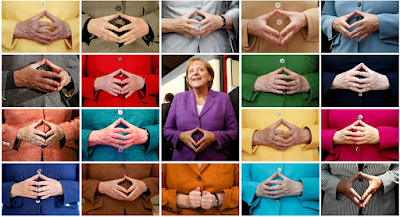
German Word of the Day - Merkel-Raute (Merkel rhombus)

 Named after the rhomboid hand clasp that Angela Merkel has long favoured:


She (and it) will be missed.

Saturday, September 25, 2021

China enters a new phase where optics are no longer important

The release of Canada's two Michaels at the exact time that Huawei CFO Meng Wanzhou was released from her house arrest and flew home to China - the two flights probably passed each other somewhere over Northern Europe - gives the official lie to all the outraged Chinese claims that there was no link between Ms. Meng's arrest and the incarceration of the two Canadian civilians.

No-one outside of China seriously doubted that the detention of Michael Spavor and Michael Kovrig was anything other than an arbitrary and spurious tit-for-tat action that is best characterized as "hostage diplomacy". But China has been at pains to insist that this was not the case, in a vain attempt to have it appear slightly less egregious in the eyes of the world. 

Most commentators - including me, I have to say - were predicting that, once Ms. Meng was released, through the intercession of American lawyers and diplomats (and almost certainly Joe Biden himself), the two Michaels would NOT be released immediately, because that would too obviously link the two events, which would be bad optics for China.

Yesterday's bland admission that, yes, the detentions were indeed targeted hostage diplomacy after all, heralds a new phase in China's relations with the rest of the world, one in which optics really don't matter to them. Long used to splendid isolation (other than what bought support they can glean from their aggressive investment and development projects in South America and Africa), China is clearly signalling that it now believes itself strong enough not to need to observe the diplomatic niceties followed by most of the rest of the world. 

China now believes it can do pretty much whatever it likes with complete impunity, because no other country dare cross it due to its economic and military power. It is up to the rest of the world, or at least those who are not completely economically beholden to China, to show that this is not the case. Canada, as a middle power at best, should take solace from the fact that it has a whole network of supportive allies in North America, Europe and parts of Asia behind it, while China is essentially, and eternally, alone.

And, of course, now that the two Michaels are out of the picture, Canada is under pressure to make its long-delayed decision on whether or not to allow Chinese company Huawei to participate in the rollout of Canada's 5G telecommunications network. Actually, Rogers, Bell and Telus, having seen the writing on the wall, are all now pursuing 5G contracts with Eriksson, Nokia and Samsung anyway, so maybe the government may not need to put their neck on the line by making an official statement (or maybe they have already been speaking to Rogers, Bell and Telus behind the scenes for that very reason).

How do the Liberals manage to win elections but lose the popular vote?

Canada's "election that changed nothing" is over, and the new government is almost identical to the old government. Failed cynical power grab? Maybe. Waste of $600 million. Sure. Overwhelming mandate for the Liberals? Not really.

The Liberals ended up with a strongish minority of 159 seats in a 338-seat parliament, or 47% of the available seats, just shy of the 50% majority position. But they got to that with just 32.6% of the popular vote. The second place Conservatives gained 119 seats (35%) with 33.7% of the popular vote. The NDP fared even worse, winning just 7% of the seats with 18% of the popular vote.

Sure, this is just a function of the first-past-the-post electoral system we are stuck with here. Plus, the share of the popular vote won by the winning party - whether Liberal or Conservative - has been on a downward trajectory since about 1970, as has voter turnout, giving the 2021 Liberals the weakest mandate in Canadian electoral history. There are now SIX major parties in Canadian politics, not just the two of a hundred years ago.

But why is it that the Liberals seem to be able to form a government with only a third of the national vote, while the Conservatives perennially win the popular vote but are excluded from power? 

The Tories, of course, are convinced that it's all due to the nefarious dealings of the Liberals, and that  they have been unfairly treated by the system. The NDP and the Greens (and even the ultra-right PPC), arguably, HAVE been unfairly treated by the system, so it's no surprise that they are strongly pushing a proportional representation electoral system (an idea that the Liberals, who once professed to be in favour of it, have mysteriously dropped since they have been in power).

But the Liberals do not come by their seats by nefarious means. This is not a case of barefaced gerrymandering, such as plagues American elections. The fact is that most of the Conservatives' support is in Western Canada, specifically Alberta and Saskatchewan, and they win some Western ridings with over 80% of the vote. So, much of their Western support is "wasted", being far in excess of what they need to win the seats. The Liberals, on the other hand, have a much higher "vote efficiency", and so are able to win more seats with fewer votes, mainly because of their geographical distribution.

So, like them or like them not, the Liberals come by their election victories fairly. If, that is, you consider the first-past-the-post system to be fair...

Thursday, September 23, 2021

Suicide rate unexpectedly plummeted during the pandemic

Well, here's a surprise. We have been hearing ad nauseum from mental health experts over the last year or two that the COVID-19 pandemic was causing a mental health crisis of unprecedented proportions, and that lockdowns are unfair, even dangerous, and can be expected to lead to widespread poor mental health outcomes and probably a rash of suicides, something I have written about before in these pages.

However, the first major Canadian study on the matter, published recently in the Journal of the Royal Society of Medicine, shows that the number of suicides in Canada actually fell by 32% during the first year of the pandemic. (A similar American study by the CDC found that suicides were about 3% down in America in 2020 - 2% lower for males and 8% lower for females - although some demographics, principally Latinos, did see a small rise.)

Suicide rates usually go up in times of economic, housing and health insecurity and, government benefits or not, 2020 was surely such a time. So, the study's authors are scrambling to explain the unexpected statistic, suggesting that maybe government-funded financial benefits and a deliberate increased focus on mental health might be the cause. Another causal factor may be the increased social cohesion the pandemic brought about, as neighbours met and helped each other out, with a sense of collective community. Well, maybe... 

The study's authors do also point out that deaths from opioid overdoses did surge during the pandemic, and intentional fatal opioid overdoses are traditionally NOT included in suicide figures for some reason (why?) Perhaps concerned for their grant funding, some researchers are suggesting that maybe the suicide rate will surge AFTER the pandemic, as people emerge from "survival mode", and "battle fatigue" starts to manifest.

The Canadian study echoes the findings of an earlier metastudy of 21 other countries which also shows a reduction in suicides rates during the pandemic, so this does seem to be a general finding. However, it should be noted that the countries that did best were those who suffered the least, both in economic and in public health terms.

Wednesday, September 22, 2021

The irony! - a shortage of carbon dioxide

In a world that is seemingly awash in carbon dioxide (CO2), and is desperately trying to reduce the amount of CO2 produced by modern human life, it is ironic in the extreme to read that the UK is staring down a major shortage of CO2  to the extent that a big potential hit to the economy is envisaged.

I had no idea, but apparently CO2 is used in a variety of industrial and commercial activities, including extending the shelf life of packaged fruit and veg and meat, cooling nuclear power plants, stabilizing body cavities during surgical operations, purifying drinking water, freezing off warts and moles, stunning livestock before slaughter, producing dry ice for transportation of fresh produce and for visual effects, and of course putting the fizz into fizzy drinks.

The UK mainly produces this industrial CO2 as a by-product of the manufacture of ammonia, alcohol and (mainly) fertilizers. Specifically, 60% of its total production comes from just two fertilizer plants in northern England owned by a US company, CF Industries, that now wants to shut down the plants. This is a prime example of the UK having too many eggs in one basket.

The biggest single input cost in CO2 production is natural gas, and surging natural gas prices have already forced some fertilizer plants to close down, leading to a shortage of CO2. The UK government has apparently struck a temporary deal with CF Industries to stay open, despite the natural gas prices, but this is only a temporary fix. Prices of CO2 are predicted to rise by up to 400%, and all of the products that rely on it, from produce to meat to nuclear power, will feel the pinch accordingly.

Thursday, September 16, 2021

Reducing polling stations "due to COVID" makes no sense

We voted the other day, not at our usual polling station, but at another one further away. It was pretty busy, considering this was advance polling and not the actual election day, but not too bad. Apparently, there are much fewer polling stations this election, "due to COVID-19".

Wait, hold on. Elections Canada has cut down on the number of polling stations "to meet physical distancing requirements"? That makes no sense. We now have more people crammed into fewer stations, longer lines, and therefore LESS physical distancing. Surely, if anything, we need MORE polling stations.

Now, apparently, some regular polling stations like schools and private businesses have declined to lend their premises for voting purposes during a pandemic, which is perhaps understandable. But that is not the major reason for the reduced number of polling stations. It's all about physical distancing.

We also had to throw away the little pencils we used to vote with (or we could take them home), another largely pointless COVID protocol. It has been many months since the idea of the virus spreading from touching things has been demoted to nonsense status. Nevertheless, millions of little pencils are being junked regardless.

It's not a big deal, in the scheme of things. You can see that they are trying to make it as safe as possible under the circumstances. It's just that so many things are described as "due to COVID-19" or " because of the pandemic" nowadays that we have almost stopped questioning them. It has become the excuse du jour (d'an?) for pretty much every non-standard or cost-cutting policy instituted anywhere, and there is little anyone can do about it, because public health and safety trumps everything.