Friday, April 09, 2021

Global minimum corporate tax rate - an idea whose time has come?

It's interesting that the idea of a global minimum corporate tax rate is finally coming into the light. The idea has, of course, been around for years, but now, with Janet Yellen and the USA showing some serious interest, it has entered into a whole new plane.

At its simplest, the idea is for an international agreement to ensure that corporations worldwide are taxed at at least some minimum rate, say 21%. Yellen says that this would "stop the race to the bottom", establish a "more level playing field in the taxation of multinational corporations", and ensure that "governments have stable tax systems that raise sufficient revenue to invest in essential public goods and respond to crises, and that all citizens fairly share the burden of financing government". 

In a minimum corporate tax rate world, countries like Canada that feel obliged to cut tax rates every time the USA does, to lower levels than they really want to, in order to remain "competitive" (i.e. to butter up global multinational companies), maybe wouldn't feel the pressure to do that. According to the IMF, average corporate tax rates have declined from 49% in 1985 to 24% today.

It would also stymie the legal but morally ambiguous activities of global corporations like Apple, Google and Starbucks in using legal loopholes in fragmented global taxation regimes to pay less tax. These huge and profitable companies shift billions of dollars in profits every year to low-tax havens like Ireland, the Netherlands, Singapore, Luxembourg and various Caribbean islands.

It all sounds eminently sensible and admirable, no? And with the USA planning to increase its corporate tax from 21% to 28% (4 years after Donald Trump reduced it from 35%), Britain planning to increase its corporation tax from 19% to 25%, and most other countries surely mulling tax increases to pay for the huge outlays needed to fight the economic effects of the coronavirus, there has probably never been a better time. Plus, the G7 and G20 are both meeting (virtually) this month.

The IMF has long been un favour of it, as has the OECD. The IMF estimates that tax havens cost governments between $500 billion and $600 billion each year, and some $200 billion of that relates to lower income economies (this is not just a rich country issue). Hell, even Canada's Justin Trudeau has said he will seriously consider it.

Of course, not everyone is on board, particularly not those countries like Ireland that have set up their whole tax system to allow multinationals to avoid tax. And people like Andrew Coyne, the Globe and Mail's resident neoconservative, who waxed lyrical in his condemnation of the idea recently, employing grandiose (and totally inappropriate) phrases like "Ozymandian" to indicate the depth of his displeasure, as well as emotive (and equally inappropriate) trigger words like "global tax cartel", "collusion" and "extortion"

Also, such a global agreement would take forever to negotiate. What would cause Ireland, for example, to embrace it (some quid pro quo may be required, but what?) And you can see it getting quite complicated: Canada, for example, has a federal corporate tax rate of just 15%, but it also has provincial corporate tax in addition of anywhere from 8% and 15% (yielding an overall tax rate of between 23% and 30%). 

But just because something is difficult doesn't mean it is not also the right thing to do.

Thursday, April 08, 2021

Canadian premiers blame the feds, and the feds blame the provinces

Ever since Canada's vaccination effort started back in January, there has been an ongoing feud between the federal government (which is responsible for acquiring the vaccine from overseas manufacturers) and the provinces (which are responsible for actually administering the doses to individual Canadians).

More specifically, there has been a feud between Conservative Premiers (principally Doug Ford of Ontario, Jason Kenney of Alberta, Brian Pallister of Manitoba and Scott Moe of Saskatchewan) and Prime Minister Justin Trudeau and Procurement Minster Patty Hajdu, with occasional but much less trenchant contributions from François Legault of Quebec and John Horgan of BC. Because most the noise is coming from Conservatives, it is pretty easy to conclude that this is a party political activity, and not one based on real logistical and healthcare concerns. It is about point-scoring and  blame-shifting. Sad, but true. For either side to accuse the other of "playing politics" seems like the ultimate in duplicity, but that's exactly what they are doing.

The viewpoint coming from the provinces is that they are ready and organized, but they just don't have enough vaccine doses to administer, whch is all the fault of the federal Liberal government, and specifically of Justin Trudeau, as thpugh he is the guy running around with a forklift truck, physically wresting doses of vaccine from those stingy foreign suppliers.

Mr. Trudeau and Ms. Hajdu, on the other hand, maintain that they have worked miracles in obtaining as many doses as they have, and that they have distributed them all with a minimum of fuss to the provinces, which have then sat on their hands, hoarding doses, and administering them in a dilatory and lackadaisical fashion.

These narratives can not both be true, but whom are we to believe? A series of tweets from Patty Hajdu the other day gives a pretty comprehensive and apparently fact-based breakdown of how many doses the federal government has obtained and shipped out to the provinces, and how many of those doses have actually been administered by the provinces. For example: Ontario has received 4,022,875 doses and administered just 2,545,640 (63%) of them; 2,370,707 doses have been provided to the province of Quebec, and 1,552,215 (65%) of them have been used; Alberta has had 1,078,215 and administered 707,482 (65%) of them; Manitoba has reveived 364,230 and used just 210,088 (58%); etc.

On the face of it, then, the provinces do seem to be sitting on stockpiles of literally millions of doses (a million-and-a-half in Ontario alone), suggesting that their roll-out is maybe not as efficient as they claim. The provinces, for their part, are crying foul, and pointing out that these figures include shipments only delivered in the last couple of days - an unspecified number of doses - which obviously they have not had chance to use yet.

As with most of these things, both sides have their own figures, and never the twain shall meet. Statistics battle statistics, and no-one ever backs down, because that is politically unpalatable. Such is politics. But wouldn't it be nice if they could put the politics aside for once, and cooperate in this national emergency. Hah! Fat chance of that!

Tuesday, April 06, 2021

Towards a quieter garbage truck

Walking around the steets on garbage day is not much fun, and not only because of the smell. Those things are just so LOUD. So, of course, I got to wondering is anyone working on a quieter garbage truck, like an electric one, for instance?

Garbage trucks, because of their unique requirements and mode of operation, typically get about 3 miles per gallon (78 L/100km to you and me), cover an average of 130 miles a day (210 km) with over 1,000 hard stops (full throttle for a few metres, full brakes, full throttle, rinse, repeat). They are just crying out for an all-electric solution.

Well, of course somebody is working on them. It turns out that there is the quadruple-battery-powered Mack LR, already in production and taking orders as we speak. The Volvo FE Electric has been used in Germany for a year or two. There is the California-based Wrightspeed garbage truck, which uses a lithium-iron phosphate battery for extra power. And there are almost certainly several others.

So, why don't we have them on our street. Well, COVID-19, for one thing (that's the excuse for most things that go wrong these days). But also up-front cost: very few municipalities are flush with cash right now, even if the long-term savings would be prodigious. Meanwhile, those noisy behemoths just keep annoying the hell out of me.

UPDATE

Fast forward 4 years to March 2025, and I just saw my very first all-electric garbage truck right here in Toronto. There has been zero fanfare, and I can't even find any reference to it on the Interwebs, but I definitely saw it with my own eyes.

It was a Mack. And it was SO QUIET! Brilliant.

Is this "the safest, most powerful wind turbine in the world"?

Well, this looks brilliant, almost too good to be true. A Salt Lake City company has developed what it calls "the safest, most powerful wind turbine in the world".

Called the PowerPod, and developed by Halcium, this is not some huge mega-turbine. The 1kW turbine is about the size of a beer barrel, and looks like a littlegreen R2D2. So, it is ideal for residential properties, public buildings, even a sailboat or camper van. The special blade system in the pod has the effect of effectively increasing wind speed by up to 40%, by funnelling it into a smaller exit before it hits the internal blade. It can more easily produce power from low windspeeds, and can use wind from any direction (useful if the wind is swirling).

It can produce up to three times the power of an equivalent traditional mounted wind turbine, and does not need to be placed on a tall, expensive pole. For this reason, it is safer too, and because the moving blades are entirely contained within the shell of the unit, it is safe to use around pets, wildlife, etc. It can be hooked up to a house or to the local grid in much the same way as solar panels, or it can seamlessly connect with an existing solar system.

The company believes that it should be a cheaper and more efficient green power solution than solar panels, particularly in areas that receive less than 300 days of sunshine a year, which is pretty much everywhere. It has produced some comparisons of the power produced by a 1kW PowerPod compared to a 1kW solar panel array in different parts of the world. In Toronto, where I live, for example, it estimates 9.9kWH  power, compared to 3.0kWH for a solar panel.

I want one! It would look very cool next to my solar panels. Production is still in its early stages, but the product is already receiving lots of buzz among potential financial backers.

Sunday, April 04, 2021

What do you call a three-pointed geometric figure?

In the east end of Toronto, there an area called Thorncliffe Park. It is a low income, immigrant-heavy neighbourhood, currently a nexus of COVID-19 cases in the city, and it is dominated by two high rise buildings which are composed of three wings radiating out from a central core. The buildings are quite distinctive, and clearly visible on Google Maps.

It got me wondering, though, what is the name of that shape: three lines radiating from a point at 120° to each other.


It's the kind of thing that really ought to have a name, whether in mathematics or in design, architecture, art, or some other pursuit. My first thought was a "three-pointed star", but it's not really a star (the three-pointed Mercedes logo is much more star-like).
Well, it seems like I am not the only one wondering. The geeks at StackExchange are on it too, but there does not seem to be a recognized name for this very basic shape. Suggestions include "Y-shape" or " inverted Y-shape", " tri-point", "triradius", "caltrop", "forked cross", "inverse hexagon", etc, etc, although none of these suggestions enjoy universal approval.

It looks like the best bet may be "forked cross" (also known as "crucifixus dolorosus", "furca", "y-cross", "ypsilon cross", "robber's cross" or "thief's cross"), which even has it own Wikipedia entry, although I am not totally happy with this because of the longer downward-pointing line (like a capital Y), its inverted orientation, and its lack of rotational symmetry.

Anyway, just idle speculation. There are probably more important issues in the world.

Saturday, April 03, 2021

Major League Baseball takes a political stand

Kudos to Major League Baseball (MLB) for making a political stand and moving the All-Star Game out of the state of Georgia in protest at their unconscionable new voting restrictions, which are aimed squarely, even transparently, at disenfranchising Black Americans and other racial minorities.

Professional sport is becoming more and more political but, given the influential position they are in, that may not be a bad thing. 

The first ever cellphone call (not by Apple, in case you were wondering)

An interesting Moment in Time in the Globe today: today is the 48th anniversary of the first official cellphone call.

The first cellphone was not the size of a brick; it was the size, and even the shape of a child's wellington boot. The call was made on April 3rd 1973 (no, not the 1990s, or even the 1980s), and it was a Motorola DynaTAC phone (no, not Apple, the Apple Computer Company did not even exist yet, and that first call was made to Motorola's closest rival, AT&T).

Friday, April 02, 2021

We need an industry-targeted vaccination push, and we need it yesterday

As Ontario heads back into what its government persists in calling a "lockdown" or "shutdown" or "emergency brake" (insert your favourite phrase here),even though those definitions have been substantially watered down in recent weeks, leading public health experts continue to criticize the Conservative governmemt's handling of the pandemic, and their ignoring of health experts' recommendations. We are in an out-of-control third wave, and drastic action is needed. 

But Doug Ford's watery "tough new measures" are not new at all. Toronto and Peel - which is where the worst numbers are, and have always been - have supposedly been locked down for weeks now, and the case numbers are still going up. How is more of the same going to make a difference? The usual inconsistencies continue: relatively low-risk activities like outside dining are being stopped, while relatively high-risk ones like indoor church services are still allowed. A group of 153 ICU doctors hace presented Ford with an open letter explaining just why his response is inadequate.

However, finally, I do believe that the right questions are being asked in a much more public way (e.g. on television news programs), in particular the idea of targeting the vaccination effort to the areas of most community spread, both geographically and industry-wise. 

The main effort so far has been targeted at age groups, in an attempt to vaccinate those most at risk of death or serious illness, which is a reasonable approach at the start. But now we have reached the stage where specific industries, racial groups and geographic areas need to be the focus, and health and infectious diseases experts are becoming increasingly vocal about it.

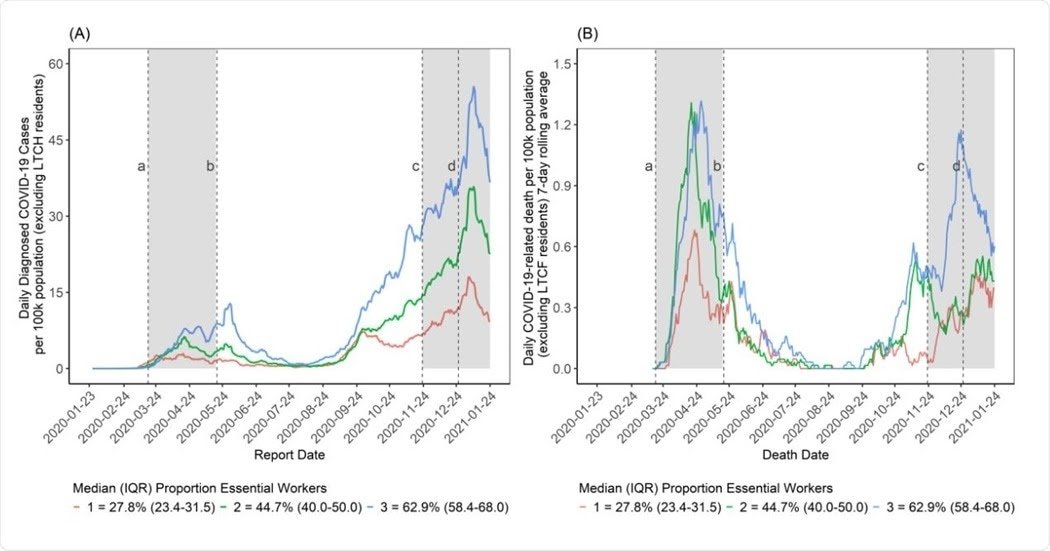
The general label that covers virtually all of those primary targets is "essential workers", whether this is healthcare workers, supermarket staff, or workers in factories, food production facilities, warehouses, distribution centres, or any number of other jobs that come under the general heading of "essential". For months now, it has been clear that essential workers are the largest single vector of new cases and viral transmission, and there is a huge disconnect between the sectors of society that are most at risk of contracting the virus (and psssing it on to others) and those who are being vaccinated.

COVID-19 cases and deaths in areas with most essential workers (blue line)

Unless and until we start vaccinating essential workers in a big way - and soon - any number of lockdowns, any analysis of whether hairdressers should be open or closed, or whether restaurants should be allowed to open their patios, is moot and all but useless.

And I don't mean just a grudging acceptance that essential workers should be allowed to compete against seniors for available doses. I mean an aggressive policy of actively encouraging vaccination in these sectors, including taking the vaccines to the workplaces, rather than just hoping that some of them will take time off work and travel to a mass vaccination centre. We finally have enough vaccine doses to be able to do this. It has to be a concerted push, and it's pretty clear that we can't rely on employers to do the right thing here. 

It's even more important to push hard because so many essential workers are racialized minorities, and so (for reasons that I still don't fully understand) are much more likely to be vaccine hesitant. We need union involvement, community leader involvement, celebrity involvement, whatever it takes to get as many of these people vaccinated as possible, for their own good and for the good of the country as a whole.

Vaccination coverage by risk areas

Paid sick leave would help too, although I've all but given up hoping for action on that.

All this is now being talked about seriously in a variety of public forums. I can only hope that it is just a matter of time before our governments realize what they need to do, and what they should have been doing for some time now.