Monday, May 30, 2022

More disingenuity from the oil patch

I seem to use the word "disingenuous" a lot in this blog, but then there's a lot of it around. Here's another example.

The US Securities and Exchange Commission is proposing that publicly-listed companies account for their total "life-cycle" greenhouse gas emissions. This includes Scope 1 emissions (greenhouse gases produced directly by the company's operations), Scope 2 emissions (greenhouse gases produced by company purchases, such as electricity to power the business), but also, critically, Scope 3 emissions (indirect emissions produced by the business, such as those emitted by end users of a company's product).

This would be a ground-breaking development, and potentially a huge step in managing carbon emissions. There is still a long way to go before such a requirement can be agreed and implemented, though, and it would admittedly be a pretty onerous requirement. There is, predictably, a lot of pushback to the idea from industry groups and Republican lawmakers. The Canadian Securities Administrators are mulling a similar rule, if the US does eventually pass it.

The requirement to disclose Scope 3 emissions in particular is being fought tooth and nail by the oil and gas lobby in the US, for obvious reasons. About 80% of the emissions of oil and gas companies are created by their end customers - after all, oil and gas companies essentially exist in order to create greenhouse gas emissions, it's what they do. For example, Cenovus Energy, which is one of only a few companies already voluntarily disclosing their Scope 1, 2 and 3 emissions, reported Scope 1 and 2 emissions of 23.94 million tons of CO2 in 2020, and 113 million tons of Scope 3 emissions.

So, you can see why fossil fuel companies don't want to disclose these emissions. But the official response to the suggestion by the Canadian oil and gas lobby group, the Canadian Association of Petroleum Producers, is the thing that I am calling disingenuous. They say, "We believe this would not only add additional burden to industry, but is also not practical in that upstream oil and gas producers don't have knowledge or control over the end use of their sales products".

So, essentially they are saying that they have no idea what happens to the oil and gas they sell. Well, I can throw some light on that. It gets burnt. That's why people buy the stuff. To say that they "don't have knowledge" of what happens to the oil and gas they sell is almost the definition of disingenuous. And clearly, Cenovus have managed it for the last couple of years at least, so everyone else could too. If you mean that you don't want to see this kind of disclosure become a requirement because it's going to be extremely embarrassing, then say that. Don't try and hide it under a bushel.

Canada is already lagging on environmental disclosure. Currently, about 70% of companies on the S&P/TSX Composite Index provide any disclosure at all on CO2 emissions, mainly reporting of Scope 1 and 2 emissions. This is slightly better than US-listed companies (67%), but well below those in Europe (89%) and the UK (99%). And you have to know which are the companies that are most reluctant to disclose their carbon footprint.

Sunday, May 29, 2022

Bizarre behaviour from Trump-backed GOP candidate

One of the Republican candidates for Governor of Georgia, Kandiss Taylor - remember her? she of the "Jesus. Guns. Babies" platform, who claimed that "We are the Church. We run this state" - received just 3.4% of the vote in the GOP primary for the governorship, placing third. Just for comparison, incumbent Brian Kemp received 73.7% of the vote. 

Nothing daunted, though, Ms. Taylor is insisting that she will not concede, and that the vote was "rigged" and a "fraud". She further explained her position: "Given that my vote total currently lags my number of volunteers by nearly 20,000, I do not trust these election results".

This is bizarre behavior, of course, but only until you realize that Ms. Taylor is a creature of Donald Trump. Trump has called on his supporters to dispute any candidate race they  do not win, even if it turns out that some of his endorsees are not actually willing to do so when push comes to shove. Ms. Taylor however is a loyal Trump supporter and willing to follow his playbook, however improbable it may seem.

This is just an early taste of how Donald Trump is planning to orchestrate the 2022 mid-terms and the 2024 presidential election. What a piece of work he is,. and what a shambles he is leading American democracy into.

No-one ever claimed that "fake meat" would save the world

The "fake meat" backlash is here (or maybe it's been here all along). Much has been made in the press - blaring headlines like "Why did it fail to deliver?" - about how badly Beyond Meat's share price is tanking (I know - we bought some just before it started tanking!), and how meat company Maple Leaf Foods Inc. is re-thinking its knee-jerk FOMO investment in plant-based meats.

I find it all a bit disingenuous. Partly, people seem to expect the precipitous increase in demand for plant-based foods over the pandemic (and in the few years before) to continue, and they feel betrayed (not that "meat meat" is doing much better). Maple Leaf Foods, for example, were expecting a 30% growth this last year, which did not pan out. That is Great Expectations indeed! Maybe they were overambitious. Maybe the problem is the whole "eternal growth" model that is at fault. 

Either way, Maple Leaf Foods' response is to lurch in the opposite direction, and try to drop it like a hot potato. Gone is any talk about "sustainability" and "moral imperative" and "the future of food" - it was only ever a means to and end (profits) for MLF. 

And that illustrates another part of the problem. Plant-based veggie burgers were hugely over-hyped, and touted as the best way to fix all our climate change woes, almost overnight (not helped by slogans like Impossible Food's ridiculous "Eat meat, save the planet"). They are veggie burgers aimed quite specifically and transparently at meat-eaters, and so, almost by definition, they are not going to save the planet. At best, they might ameliorate the planet-killing habits of confirmed carnivores. Pretend-meat burgers like Beyond and Impossible are not even that healthy (and I still prefer the taste of the healthier old-style veggie burgers like Yves and Sol).

Which leads me to my third point. Such is the hype surrounding these products that they are often described as though they are expected to SINGLE-HANDEDLY "save the world". Obviously, that is a ridiculous and clearly unattainable goal, that no honest environmentalist (or food company for that matter) would ever claim. That, of course, makes it all the easier to claim that they are "failing" to live up to their hype. (This is similar to the anti-renewables lobby claiming that wind power will never replace coal, ot that solar energy will never be sufficient to phase out nuclear power stations - no-one ever claimed that individual renewable power sources would "save the world", just that wind, solar, tidal, geothermal, etc, are all just elements of a responsible energy mix.

So, yes, a vegetarian/vegan diet is better for the environment, in many different ways, but meat substitutes - can we maybe avoid the loaded term "fake meat"? - like Beyond Meat and Impossible Foods are just one little element of that. The heavier lifting should be taken by nuts, high-protein grains and pulses like chick peas, lentils and beans. And should plant-based foods be expected to save the world AND give opportunistic investors a good return.

Journalists and reporters need to be more responsible and less cavalier in their reporting of these matters, and to stop attributing unattainable claims that no-one is really making. And don't get me started on that whole "fake meat" descriptor...

Saturday, May 28, 2022

Airports are blaming COVID restrictions for airport chaos, but really they were just not ready

The crush, chaos, delays and line-ups at Toronto, Vancouver and Montreal airports (but mainly Toronto) has been well-documented. When we follow to Nicaragua at the end of March, the airports were deserted and the flying experience was actually remarkably pleasant. By the time my daughter flew to Belize at the beginning of May, it had devolved into chaos, and she took over four hours to traverse the airport, both leaving and arriving. 

But many of the suggested solutions are sounding a but disingenuous to me. The default position when anything goes wrong is to blame the government, and that is exactly what is happening here. 

The International Air Transport Association (IATA) is blaming government-imposed COVID-19 checks and restrictions for the delays, and insists that the government summarily remove the last few restrictions that still remain, even the the restrictions that do remain in place are miniscule compared to just a few short months ago. The Canadian Airport Council also takes this line. A bunch of Canadian tourism organizations and assorted "business leaders" have also called for COVID protocols be done away with. It's like a slightly better-behaved truckers convoy, almost over again.

What is actually happening, though, is that international travel to Canada is booming (partly BECAUSE pandemic restrictions have been largely lifted), as well as Canadians themselves suddenly travelling while the going is relatively good, and the airports and travel industry were just not ready for it. At Pearson Airport in Toronto, for example, about 7,400 staff performed the security and administration work before the pandemic; currently, only 6,500 are doing that work. 

The airports took their eye off the ball, and did not see what was happening, and what it was pretty obvious would happen. Accusing the government and the pandemic rules is just them trying to shift the blame and an uncomfortable narrative, in my opinion.

And bear in mind that medical authorities are saying that the checks and restrictions at airports are still needed and still serve a purpose, including keeping out new variants. "They are inconvenient but they are, at this time, still necessary", as one infectious diseases researcher explains. The World Health Organization points out that, although cases worldwide are falling (although mainly because much less testing is being carried out), even that is not the case in the Americas and in Africa.

So, with blame and aspersions being cast around left, right and centre, a bit of perspective and consideration is needed here. In the scheme of things, the COVID checks are not that onerous. If we want to "live with COVID", as I keep hearing we do, that does not mean that ewerything will be just like it was back in the innocent and naive days of 2019.


The COVID-19 stock crash in perspective

There was an interesting graph in today's Globe and Mail Report on Business magazine, which I had to photograph as I couldn't find it online.


It shows the performance of the Toronto Stock Exchange (TSX) in the two years or so following the major stock crashes of the last 100 years or so: the COVID-19 Recession (from January 2020), the Great Recession (from August 2008), the Dot-Com Crash (from August 2000), Black Monday (from September 1987), the Double-Dip Recession (from June 1981), the 1970s Oil Crisis (from October 1973), and the Great Depression (from September 1929).

We're accustomed to thinking of the recent COVID-19 crash as being a devastating event financially. Well, as the graph shows, although it has been devastating socially and societally, and although it was one of the sharpest initial downturns of all, it has been anything but devastating in the longer term. The actual downturn (before the TSX returned to the black) only lasted 9 or 10 months, and since then the exchange has been booming. And, except for a few unrelated and relatively minor setbacks, they haven't looked back since. Even with the recent hiccough due to the Russian invasion of Ukraine, the TSX is still about 20% up on pre-COVID levels, and about 45% up from the worst point, in March 2020.

ALL of the other recessions mentioned have been substantially worse after two years, by far the worst being the Great Recession of the early 1930s, followed by the Dot-Com Crash, the 1970s Oil Crisis and the Great Recession of 2008-9. Two years after the Great Depression, stocks were still 70% down (at its worst, the COVID-19 crash only saw a 25% hit, on the TSX at least).

It's good to get a potential perspective.

Friday, May 27, 2022

The hopelessly split left makes me sad

It makes me sad when I look at polls for the upcoming Ontario provincial election. 

I see, as of today, less than a week before the election date, Doug Ford and his so-called Progressive Conservative Party in the driving seat to win a second term with about 36% of the popular vote, but with 65% of the seats, a handy and apparently unassailable majority. That's one of the things that makes me sad: the absence of proportional representation, and the severely skewed seat allocations that the first-past-the-post system causes.

But the other thing that makes me sad is the hopelessly split left-wing vote. Behind Ford, are Stephen Del Duca's Liberals with 28%, Andrea Horwath's NDP with 23% and Mike Shreiner's Green Party with 7%. So, fully 58% of Ontarians want a leftist party to be elected, but we are still going to end up with a rightist party in power.

The Liberals and NDP, both provincially and nationally, are really not that different from one other policy-wise, even if they fall over backwards trying to distinguish and separate themselves. If they would only, swallow their party pride and amalgamate, Ontario (and Canada as a whole for that matter) would permanently reflect the left-wing bias that the province (and  the country) apparently naturally has. A few hard-core Liberals and Democrats might object to such a merger, but I think the majority would be happy to compromise on certain issues if it meant that a progressive, left-of-centre agenda could be permanently pursued.

Either way, the status quo seems irremediably broken. And that makes me sad.

UPDATE

As expected, and as polled, the Ontario Conservatives won a huge (increased) majority. They ended up with 83 seats, the NDP 31, and the Liberals a paltry 8. It's all inexplicable to me, but I guess people like Doug Ford (and his policies)?

In terms of the popular vote, though, the NDP and Liberals together received 47.5%, and the Conservatives only 40.8%. I don't have the figures to hand - I don't even know if anyone has done the exercise - but it is quite possible that a merged NDP-Liberal Party could have won this election (this, of course, depends on the concentration of votes in particular ridings, etc, and is not just an extrapolation of the popular vote).

In this particular election, not many people on either side seemed very engaged: voter turn out was an all-time low of 43%. In some ridings it was under 35%! Nearly half a million fewer people voted for Doug Ford and his Conservatives as did in 2018 (1.9 million, compared to 2.3 million), so it's hard for him to be too positive about his re-election. However, the second-place NDP fared even worse, with 1.1 million votes compared to 1.9 million in 2018. Apathy on both sides, but more on the left than the right.

Either way, until the two parties put their history and their pride behind them, we could end up with a Tory government forever, and that is is nobody's interest, and does not reflect the will of the people. Or, of course, a proportional representation electoral system would also work, but don't hold your breath for that.

Obviously, I'm not the only one calling for this, but the imperative is now much clearer and starker, and the time for idle speculation is over.

Thursday, May 26, 2022

Sorry, your 50-year old smallpox vaccine won't help you with monkeypox

Monkeypox is the next COVID. Well, not really. The two are hardly comparable. Monkeypox is related to smallpox (both are orthopoxviruses) although usually less severe and less contagious. Symptoms include fever, muscle aches, skin rashes, swollen lymph nodes and headache. It typically lasts from 2 - 4 weeks, and the fatality ratio is relatively low, in the region of 3 - 6%. It mainly occurs in west and central Africa, but there has been a rash [sic] of cases in the West, which is freaking people out. Many of the early cases occurred particularly, although not exclusively, among men who have sex with other men, but note: it is not a "gay disease", and it is not even sexually transmitted, but is spread by close contact, clothed or not. Over 200 confirmed or supected cases have been identified in over 20 countries, with more new cases being reported every day.

But wait, you say, I've heard that older people who have been vaccinated against smallpox as a child - as I think I have, although I have no proof - are protected against monkeypox. Well, sorry, but that is almost certainly not the case

Like with most vaccinations, immunity wears off over time. Routine smallpox vaccinations ended back in the early 1970s, some 50 years ago, even though smallpox worldwide was not eradicated until 1980. However, neutralizing antibodies decline significantly over 5 to 10 years, which is why the smallpox vaccine used to require boosters every 5 to 10 years. Because the disease was considered eradicated, though, obviously no-one bothered with boosters after the 1970s. 

Ergo, any smallpox vaccines you might have received already are not going to be any use at all to you now, 50 years later, either against smallpox or against monkeypox. Some older studies have shown that the smallpox vaccine was of some use in reducing the severity of the disease for up to 20 years, but even after 20 years its efficacy was minimal (and zero against actually catching the disease). So, after 40 or 50 years ... well, you catch my drift.

However, many countries do still have stocks of the smallpox vaccine, for emergency purposes, and so medical staff who may be exposed to the current monkeypox outbreak could use it to give some protection, as is currently happening in the UK. The monkeypox outbreak is relatively small, though, and because it is not that contagious (compared to COVID for example), it is expected to be controllable, so mass vaccinations are unlikely.

US mass shootings are starting to fade into each other

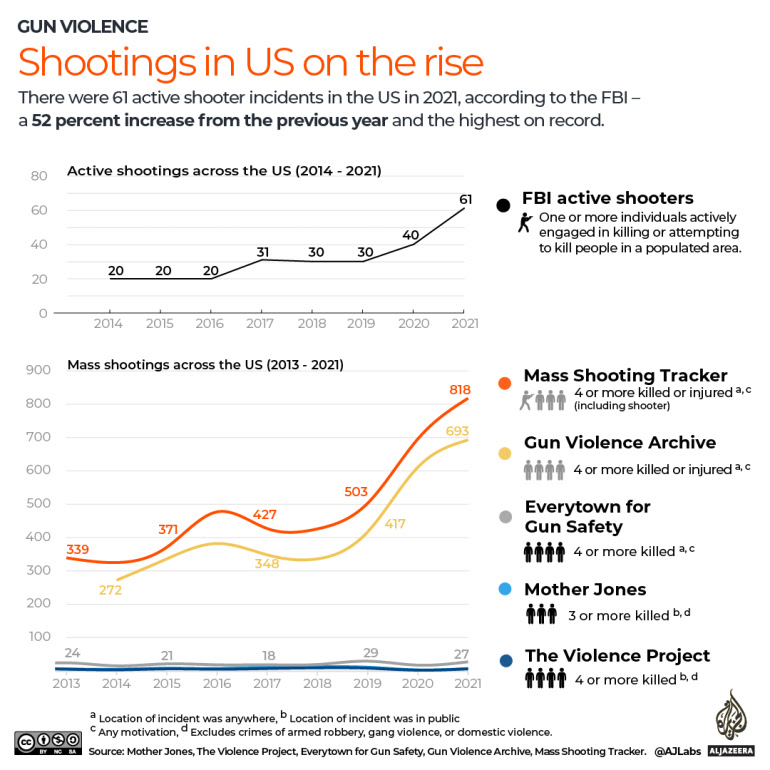
bunch of charts and graphs in the Globe and Mail today attempts to illustrate gun violence in the United States, on the grounds that words no longer suffice. It's well-worth perusing.

Tuesday's shooting at Robb Elementary school in Uvalde, Texas, in which 19 children and 2 teachers lost their lives, only features at No. 9 in the lust of deadliest US mass shootings since 1982. It was only the 3rd deadliest school shooting, paling into relative insignificance compared to 2007's Virginia Tech shootings and 2012's Sandy Hook massacre.

The top 5 deadliest mass shootings were Las Vegas Strip, Nevada (2017, 60 deaths), Orlando Nightclub, Florida (2016, 49), Virginia Tech, Virginia (2007, 32), Sandy Hook elementary School, Connecticut (2012, 27) and Texas First Baptist Church, Texas (2017, 26).

Wait, 60 people were shot in Las Vegas as recently as 2017? Why don't I remember that? (I checked and my wife doesn't either.) I have no real memory of the event at all. Now, I know my memory is not what it was, and I know I live in relatively civilized Canada, but US news is a big part of Canadian news and I do tend to follow current affairs. So, why don't I remember this? Maybe I was away somewhere? (Nope, I just checked, and on 1 October 2017 we were doing a ravine clear-up right here in Toronto.) I remember Orlando. I remember Sandy Hook. Virginia Tech vaguely. Texas First Baptist not so much. But Las Vegas Strip? Nothing.

I guess there have been just so many mass shootings in the USA that we become innured, desensitized, blasé, especially as American shootings seem somehow so distant (they're not), so exotic (definitely not). One just fades into another. We have shootings here in Canada too, more and more it seems, but not in the same kind of league as the US. Depending on which definition you favour, there have been either 1, 3, 7, 230 or 268 mass shootings in America in the first 5 months of 2022 alone. Regardless of definitions, though, mass shootings have been on a steady upward trend.

The fact that I have no memory of the shooting of 60 people just 5 years ago is shocking, shameful and depressing. For what it's worth, here is a news report on the Las Vegas Strip shooting of 1 October 2017. It occurred during an open-air country music festival right on Sin City's main Strip, and the shooter, 64-year old Stephen Paddock, sprayed the crowds with bullets from the 32nd floor of the Mandalay Bay Hotel for no apparent reason, killing 60 and injuring 411 (the ensuing panic brought the number of injured up to 867). Even today, his motive, as Wikipedia notes, is "officially undetermined" - Islamic State's attempts to take "credit" for the shooting have been dismissed as opportunistic claptrap - and Paddock killed himself before police could apprehend him.